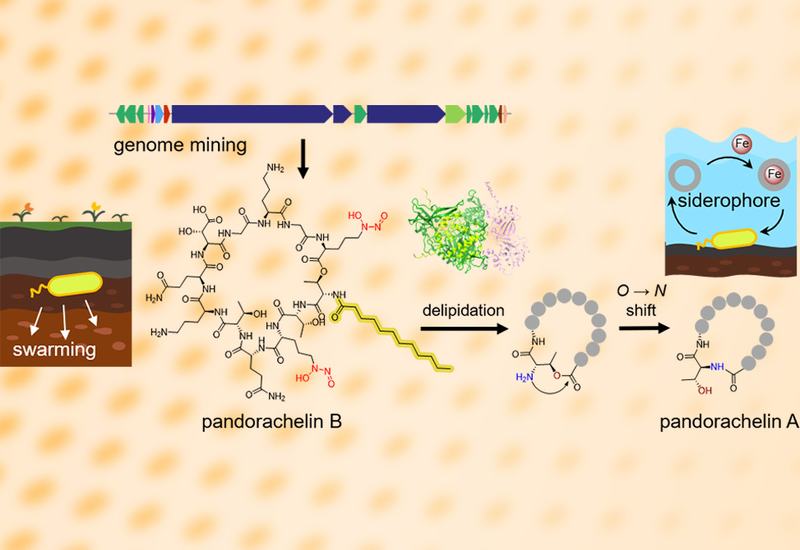
Bacterial siderophores are conventionally understood as dedicated iron-scavenging molecules, shaped by evolution to chelate Fe³⁺ with high affinity and return it to the cell. That framing leaves little room for a molecule that must also solve a separate ecological problem: how to move through a surface before iron becomes the limiting constraint. Pandoraea species, Gram-negative opportunistic pathogens increasingly found in cystic fibrosis patients and known for antibiotic resistance, face exactly this tension. Genome mining had hinted that several Pandoraea strains harbor a biosynthetic gene cluster encoding diazeniumdiolate-containing natural products related to gramibactin, but the nature and function of the encoded metabolites remained unknown, and no mechanism existed to explain how a single biosynthetic pathway might serve two distinct physiological roles.
Researchers in the Hertweck Lab at the Leibniz Institute for Natural Product Research and Infection Biology, published in Angewandte Chemie International Edition, discovered that the pdn gene cluster encodes two structurally distinct but biosynthetically linked cyclopeptides: pandorachelin B, a lipocyclopeptide bearing a dodecanoyl chain and a lactone ring closure, and pandorachelin A, a head-to-tail homodetic cyclopeptide that forms when the specialized acylase PdnM cleaves the fatty acid tail. That cleavage liberates the N-terminal threonine amine, which spontaneously attacks the adjacent lactone carbonyl in an O→N acyl shift, contracting and remodeling the ring. Genetic knockouts confirmed that PdnM is both necessary and sufficient for the conversion: a pdnM deletion mutant accumulates only the lipopeptide precursor, while recombinant PdnM reconstitutes the full transformation in vitro. The functional consequences are sharp: pandorachelin B acts as a biosurfactant enabling swarming motility, whereas pandorachelin A, the delipidated product, binds Fe³⁺ with measurably greater potency.
The ecological logic becomes clear when comparing strains by habitat: the soil-dwelling Pandoraea horticolens retains substantial pandorachelin B and swarms, while the aquatic Pandoraea norimbergensis converts nearly all precursor to the chelator. PdnM activity level, not gene expression, appears to govern the ratio between forms, pointing to the acylase as a tunable switch for niche adaptation. The identification of PdnM as a potential antivirulence target, and the broader principle that NRPS-derived lipopeptides may encode cryptic dual functions resolved by post-assembly enzymatic editing, invites a fresh look at related biosynthetic pathways across the microbial world.